 PetCalculator.net
How Much to Feed a Poodle (Miniature)
Get a precise daily feeding amount for your Poodle (Miniature) based on veterinary RER/MER formulas, adjusted for their weight, life stage, and activity level. Free, no sign-up.
Free • No sign-up • Vet formula-based
Poodle (Miniature) at a glance
- Breed Group Non-Sporting
- Adult Weight 10–15 lb
- Male 11–15 lb
- Female 10–14 lb
Life stage timeline
Feeding considerations
It's easy to overfeed a small breed like the Miniature Poodle using cup measurements meant for larger dogs, and even a small amount of extra weight represents a larger percentage of this breed's body mass than it would for a bigger dog. This is general guidance, not a substitute for advice from your veterinarian. Not medical advice, consult your vet.
Energy & temperament
Bright, eager to please, and generally easier to keep active than the larger Standard Poodle simply due to smaller size. Miniature Poodles are prone to being fed like a bigger dog by owners underestimating how few calories their small frame actually needs.
Health & feeding notes
Senior life stage starts later than the size-class default
Miniature Poodles are consistently among the longer lived small breeds. Large-scale UK veterinary data cited in a 2022 Royal Veterinary College VetCompass study puts median age at death for the breed at roughly 14 years, though that specific breed-level figure comes from a smaller underlying sample and is best read as directional rather than exact. Applying the standard veterinary guideline that senior status begins in the last quarter of a dog's expected lifespan puts senior onset for a Miniature Poodle closer to 11 years old rather than the generic 10-year small-breed default. That extra window matters, since switching to a lower-calorie senior formula too early in a still-active dog can under-fuel them unnecessarily.
Miniature Poodles carry a real, documented diabetes risk
Analysis of a large North American veterinary database found Miniature Poodles diagnosed with diabetes mellitus at close to double the rate of mixed-breed dogs, a finding that has held up across multiple independent studies over several decades. The exact trigger isn't fully understood, but keeping a Miniature Poodle at a lean body condition is the single most effective thing an owner can control, since excess body fat directly worsens insulin resistance. Diets with meaningful fiber content and without a heavy load of simple carbohydrates or treats are a sensible default for this breed, not just for dogs already diagnosed.
Don't assume Standard Poodle health risks apply here
A lot of generic Poodle health content lumps all three sizes together, and that's misleading for owners of a Miniature. Bloat, or gastric dilatation volvulus, is a genuine emergency risk tied to the Standard Poodle's deep, narrow chest, and it isn't a documented hazard for the Miniature's build in the same way. Addison's disease follows a similar pattern: genetic research has traced it to a specific inbred lineage within Standard Poodles, and Miniature Poodles are genetically distinct enough from that population that they are sometimes used to outcross Standard lines away from the disease. Neither risk should be assumed for a Miniature Poodle without an actual diagnosis.
Kneecaps and hip joints benefit more from lean weight than any supplement
Patellar luxation, where the kneecap slips out of its groove, and Legg-Calve-Perthes disease, a loss of blood supply to the top of the thigh bone, are both structural conditions documented in small breeds including the Miniature Poodle. Neither is caused by diet, and neither can be fixed by it. What diet and feeding do control is body weight, and keeping a Miniature Poodle lean measurably reduces the mechanical load on both joints and can slow how much an existing joint issue progresses. If your dog has a diagnosed joint condition, weight management is worth treating as seriously as any medication your vet prescribes.
The coat hides weight gain, so check by hand, not by eye
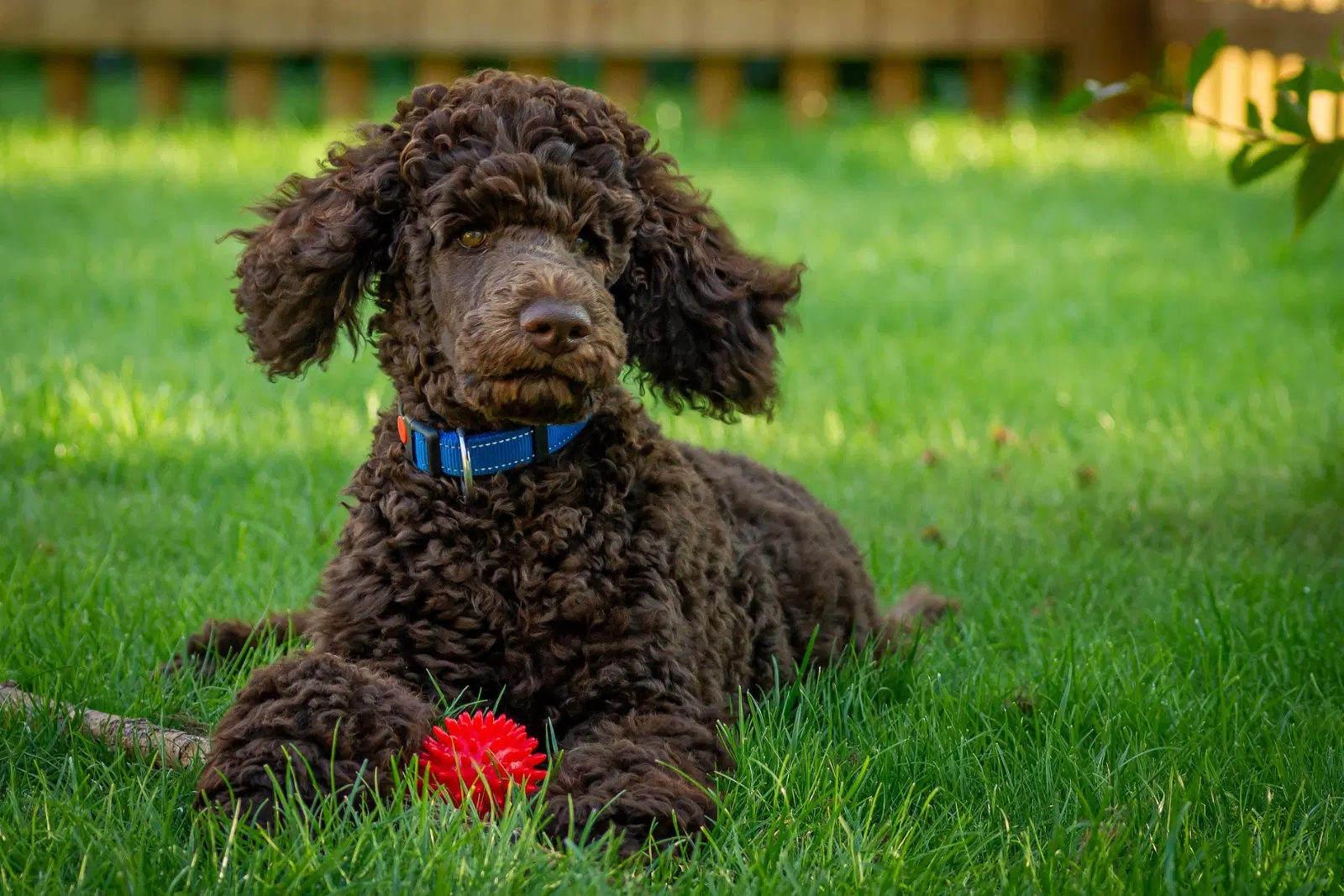
A Miniature Poodle's dense, curly coat is genuinely difficult to judge visually, which means owners can miss early weight gain that would be obvious on a short-haired breed. Run your hands along the ribcage; you should feel individual ribs under a thin layer of fat without pressing hard. There should be a visible waist behind the ribs and a slight upward tuck of the belly when you look from the side. If you can't find any of these by feel, it's worth a conversation with your vet regardless of what the scale says, since visual impressions alone are unreliable on this coat type.
Small portions mean small mistakes cost more
An adult Miniature Poodle's entire daily calorie budget often falls in the 300 to 400 kcal range, a fraction of what a medium or large breed needs. Because that total is so small, a measuring-cup error of even a tablespoon or two of kibble can represent a meaningfully larger share of the day's intake than the same error would for a bigger dog. Weighing food on a kitchen scale rather than eyeballing a cup is a more reliable way to keep portions consistent for a breed this size, especially if weight management or diabetes risk is already a concern.
Poodle Feeding FAQ
How much should I feed a Miniature Poodle puppy?
Miniature Poodle puppies typically need 3 to 4 smaller meals a day through about 9 months, tapering to fewer, larger meals as they approach their first birthday. Enter your puppy's current weight and age into the calculator above for an exact daily amount.
How much should an adult Miniature Poodle eat per day?
Most adult Miniature Poodles need well under a cup of quality dry food per day, split into two meals. Because their daily calorie budget is so small, precise measuring matters more here than it does for larger breeds. Use the calculator above for a precise number.
When does a Miniature Poodle become a senior dog?
Later than the generic small-breed rule of thumb suggests. Miniature Poodles are a long-lived breed, and applying standard veterinary guidance for senior onset, the last quarter of a dog's expected lifespan, to breed-level longevity data puts the senior transition around 11 years old for most Miniature Poodles, rather than 10.
Are Miniature Poodles prone to diabetes?
Yes, more so than most breeds. Multiple independent veterinary studies have found Miniature Poodles diagnosed with diabetes mellitus at close to double the rate of mixed-breed dogs. Keeping your dog at a lean body condition throughout life is the most effective thing you can control to lower that risk.
Should I feed my Miniature Poodle a grain-free diet?
Not without a specific reason from your vet. The FDA has flagged a possible, still not fully understood association between certain grain-free diets, particularly those high in peas, lentils, or other legumes, and a heart condition called dilated cardiomyopathy in some dogs. Unless your Miniature Poodle has a diagnosed grain sensitivity, a standard grain-inclusive diet from a manufacturer that runs its own feeding trials is the safer default.
How can I tell if my Miniature Poodle is overweight under all that coat?
By feel, not by eye. Run your hands along the ribcage. You should feel individual ribs under a thin layer of fat, a visible waist behind the ribs, and a slight upward tuck of the belly from the side. The coat makes visual checks unreliable, so this hands-on check is worth doing regularly.
What activity level should I select for a Miniature Poodle in the calculator?
Most healthy adult Miniature Poodles do well selecting an active or moderately active tier. They were originally bred as water retrievers and generally have real stamina for their size, often benefiting from 45 to 60 minutes of exercise a day. Adjust down if your individual dog is less active, neutered, or already prone to weight gain.
Do Miniature Poodles need joint supplements for their knees?
Not automatically. Patellar luxation, a kneecap that slips out of place, is a structural condition documented in the breed, and it isn't caused or fixed by diet or supplements. What you can control is your dog's weight: keeping a Miniature Poodle lean reduces the physical load on the joint and can slow how much a diagnosed luxation progresses. If your dog has a confirmed joint issue, talk to your vet about whether an omega-3 supplement is worth adding, but it's not a substitute for weight management.